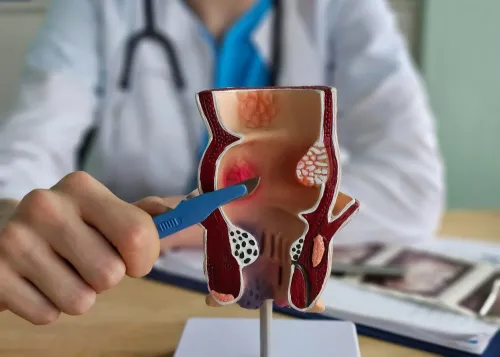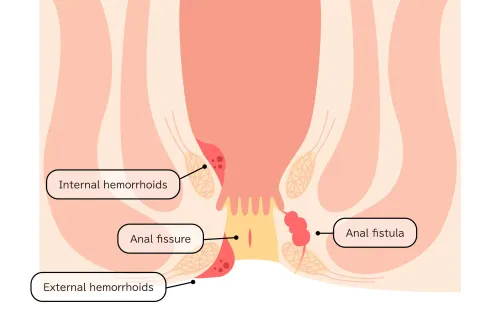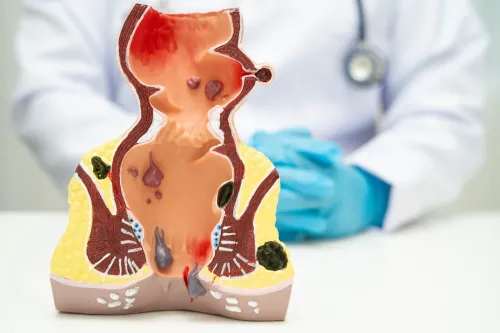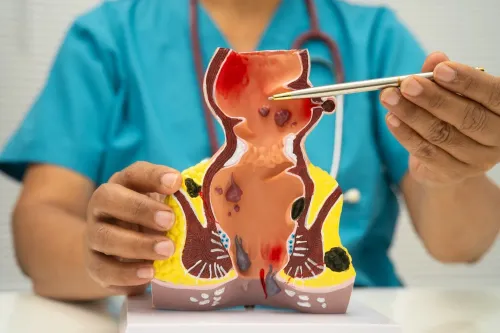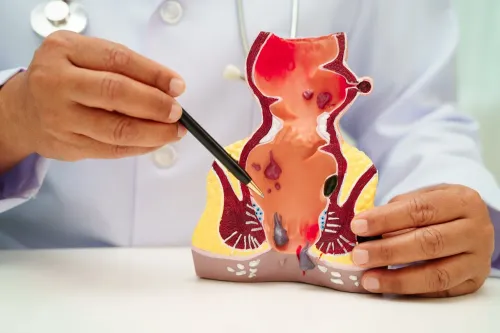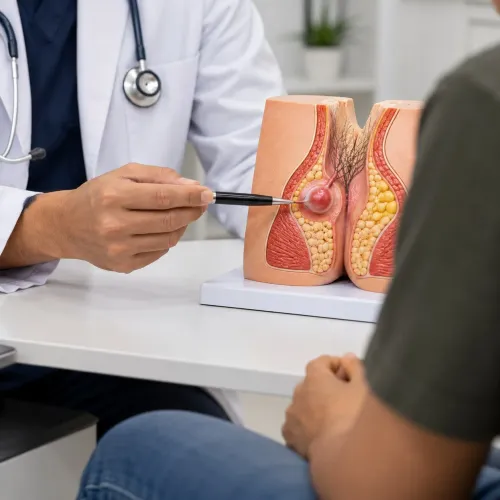

Laser treatment in proctology is not one operation: the fibre may shrink haemorrhoidal tissue, divide a fistula tract, seal it from within, or affect the internal sphincter. By matching the technique to the condition, its anatomy, and the alternatives, you can judge when laser offers a useful recovery advantage and when another treatment is more reliable.
Key takeaways
- Laser proctology is a technique, not one operation.
- Hemorrhoid size and prolapse determine whether laser treatment fits.
- Fistula anatomy decides whether laser can protect the anal sphincter.
- Ask about recurrence, healing time, alternatives and surgeon experience.
What laser proctology does inside the body
Laser proctology does not describe one operation: it uses a laser probe or laser fibre to deliver controlled heat to a specific target—hemorrhoidal tissue, a fistula tract, or the internal anal sphincter.
The laser is not treating “the rectum” generally, and rectal bleeding still needs examination; atypical symptoms, anemia, screening needs, or risk factors can require endoscopy.
| Procedure | What the energy does | Main target |
|---|---|---|
| Laser hemorrhoidoplasty | A laser fibre beneath the mucosa heats and contracts the vascular cushion; this laser hemorrhoidoplasty mechanism reduces blood flow and prolapse without removing the cushion. | Selected internal hemorrhoids |
| Laser fistulotomy | The laser opens and coagulates a suitable low fistula tract, similar in purpose to laying the tract open surgically. | Simple fistulas with limited sphincter involvement |
| Laser fistula ablation (FiLaC) | A radial laser fibre thermally destroys the tract from inside while aiming to preserve the sphincter. | Complex or sphincter-involving fistulas; healing is variable |
| Laser internal sphincterotomy | The laser divides part of the internal sphincter to reduce resting pressure. | Selected chronic anal fissures |
Laser fistulotomy and fistula ablation are not interchangeable: one opens the tract, while FiLaC seals and destroys it internally. Laser hemorrhoidectomy, where tissue is cut out, is also different from tissue-sparing hemorrhoidoplasty and resembles conventional excision more closely. The choice depends on anatomy, prolapse, external disease, sphincter involvement, and diagnosis—not the word “laser” alone.
When laser hemorrhoidoplasty fits—and when another treatment is better
Laser hemorrhoidoplasty suitability depends on anatomy, not the word “laser.” It is usually considered for symptomatic internal hemorrhoids, especially grade II and selected grade III disease, after fibre, adequate fluids, less straining, and shorter toilet sitting have not controlled bleeding or prolapse.
It is a poor fit for a large external component, acutely thrombosed external hemorrhoids, or grade IV prolapse that remains permanently outside.
| Option | What it means | When it applies |
|---|---|---|
| Office procedures | Rubber-band ligation, infrared coagulation, or sclerotherapy treat the internal bleeding or prolapse point without a surgical wound | Often suitable for grade I and II hemorrhoids and selected grade III hemorrhoids |
| Laser hemorrhoidoplasty | A probe delivers laser energy beneath the internal hemorrhoid to shrink vascular tissue while preserving the surface | Consider selected internal grade II–III hemorrhoids with limited external disease and manageable prolapse |
| Conventional hemorrhoidectomy | The surgeon removes enlarged hemorrhoidal tissue, including substantial prolapsing or external components | Often better for large grade III or grade IV hemorrhoids, mixed internal-external disease, or failed less-invasive treatment |
| Stapled hemorrhoidopexy | A circular stapler lifts prolapsing internal tissue rather than excising every external lump | Consider selected circumferential internal prolapse, after discussing recurrence and other risks |
Laser can mean smaller wounds, less early pain, and faster return to routine, but published studies use different devices, energy settings, and follow-up periods. Conventional surgery may control advanced prolapse more reliably, while any option can cause bleeding, urinary retention, infection, recurrence, or another procedure. Ask which grade and component you have before choosing.
How fistula anatomy determines the safest procedure
The safest procedure depends on anal fistula anatomy, especially how much functioning sphincter surrounds the tract. The external opening shows where drainage reaches the skin; the internal opening, usually identified during examination or imaging, shows where the fistula begins.
1. Drain an abscess first. A painful swelling, fever, pus collection, or spreading redness requires incision and drainage; laser fistula ablation cannot replace source control. After infection settles, the surgeon can define the remaining fistula.
2. Map the tract. A short, straight tract with one external opening, one internal opening, and little sphincter involvement is usually suitable for fistulotomy. The surgeon opens the tract so it heals from the base outward. Laser fistulotomy may be considered in selected anatomy, but “laser” does not remove the need to divide tissue safely.
3. Look for complexity. High tracts, multiple branches, recurrent disease, anterior fistulas, Crohn’s disease, or substantial external and internal sphincter involvement raise the risk of impaired gas or stool control after division. A seton, advancement flap, or ligation of the intersphincteric fistula tract can protect the sphincter while treatment proceeds in stages.
4. Consider FiLaC when closure without cutting the sphincter is the priority. This laser fistula ablation passes a fibre through the tract and thermally seals it from inside. Healing is less predictable than fistulotomy for a simple low fistula, and recurrence or repeat treatment remains possible.
Where laser fits in fissure care—and what risks remain
No: laser internal sphincterotomy is not ordinarily first-line anal fissure treatment. For a chronic anal fissure, clinicians usually start with fibre, stool-softening measures, and topical nitroglycerin or a calcium-channel blocker. Botulinum toxin or conventional lateral internal sphincterotomy enters the discussion when medical treatment fails; laser evidence remains less established.
1. Confirm that the pain and tear are truly a fissure. Examine for abscess, fistula, inflammatory bowel disease, atypical location, or a mass. Biopsy any suspicious lesion; laser ablation without diagnosing cancer can delay staging and proper oncologic treatment.
2. Assess the sphincter before cutting or heating it. Record existing flatus or stool-control problems, previous sphincter injury, childbirth-related injury, and earlier anorectal operations. A procedure that weakens the muscle can produce continence problems even when the intended injury is small.
3. Discuss the operation’s limits and postoperative risks. These include pain, bleeding, infection, urinary retention, thrombosis, delayed healing, thermal injury, recurrent fissure, and another operation. Ask how the surgeon controls laser depth and how follow-up will detect a persistent wound or continence change.
Laser is therefore a selected option, not a universal upgrade. Avoid treating a visible lesion until its diagnosis is established, and compare the proposed laser procedure with proven medical care, botulinum toxin, and standard sphincterotomy for your anatomy and risk profile.
Questions to ask before choosing laser treatment
Ask for the exact procedure, not just “laser”: laser hemorrhoidoplasty, laser fistula ablation, laser fistulotomy, and laser internal sphincterotomy treat different tissues. In a laser proctology consultation, ask how your examination confirmed the diagnosis, whether you need imaging, examination under anaesthesia, or biopsy, and whether an abscess requires incision and drainage before anything else.
Ask these questions before consenting:
- What result is realistic for my haemorrhoid grade, fistula tract, or fissure?
- What are the laser treatment alternatives, and why is this option safer or more effective for me?
- What is my continence risk, considering previous surgery, existing leakage, and sphincter involvement?
- What are the chances of recurrence after laser treatment, retreatment, or a second operation?
- How many days until walking, working, exercising, and passing stool comfortably?
- Who reviews the wound, and when are the follow-up visits scheduled?
Compare the recommendation against the actual trade-offs:
| Option | Recovery | Recurrence and continence |
|---|---|---|
| Laser procedure | Smaller treated area and quicker early recovery in selected cases | Recurrence or retreatment remains possible; risk depends on the operation and sphincter involvement |
| Office treatment | Often the least downtime for suitable internal haemorrhoids | May require repeated sessions; it does not correct advanced prolapse |
| Conventional or staged surgery | More pain and wound care, with a longer recovery | Can provide more durable treatment for advanced prolapse or complex fistula, but carries procedure-specific continence risks |
Shree Hospital - 08048060809 can help you compare its proposed operation with these alternatives by asking for the written diagnosis, expected follow-up, and backup plan if healing fails.
Related services
Pile Fissure and Fistula Piles (hemorrhoids) can cause discomfort, pain, and embarrassment, affecting your daily life and confidence. View service → |
Pile Fissure and Fistula Living with an anal fistula can be painful, uncomfortable, and emotionally distressing. View service → |
Frequently asked questions
What does laser proctology do inside the body?
A laser probe or fibre delivers controlled heat to a specific target, such as hemorrhoidal tissue, a fistula tract or the internal anal sphincter.
When is laser hemorrhoidoplasty a suitable treatment?
Laser hemorrhoidoplasty fits selected internal hemorrhoids, especially when reducing tissue volume is appropriate. Large, prolapsed or external hemorrhoids may need another procedure.
How does fistula anatomy determine the safest procedure?
The surgeon must map the fistula’s openings, branches and relationship to the anal sphincter. A procedure that protects sphincter muscle takes priority over using laser.
Where does laser fit in fissure treatment?
Laser has a limited role in fissure care. Treatment depends on whether the fissure is acute or chronic, the sphincter’s involvement and response to medicines or other procedures.
What questions should you ask before choosing laser treatment?
Ask which condition and grade the procedure treats, what alternatives exist, expected recurrence, healing time, complications, surgeon experience and the plan if laser treatment fails.
Related services
Other Surgies Chronic anal fissures can cause intense pain, discomfort, and difficulty during daily activities like sitting or passing stool. View service → |
Pile Fissure and Fistula Anal fistula is a painful and recurring condition that can affect your comfort, confidence, and daily routine. View service → |